Shopping Day!
How has French colonialism influenced the simplicities of clothing and food?
Follow a story of a mother and her daughter facing the changes of clothing and food through clicking our Twine game “Shopping Day” link below or scrolling down!
Project Statement
Throughout our project we seek to explore how French colonialism influences the simplicities of clothing and food in Vietnam. We examine how French colonial rule introduced Western styles, fabrics, and culinary influences, to create a hybridity that blended traditional Vietnamese elements with colonial imports.
One prominent example is seen with the transformation of the Vietnamese national dress–the áo dài. Fashion designer Nguyễn Cát Tường’s iconic “lemur” tunic in the 1930s incorporated Western trends such as puffed sleeves and diaphanous fabrics into the traditional garment. Beyond aesthetic changes, colonial influences also shaped societal attitudes and beauty standards for Vietnamese women.
Our project focuses on these tangible changes while also exploring the emotional experiences of women during the time, comparing generational differences between mother and daughter through our Twine visualization.
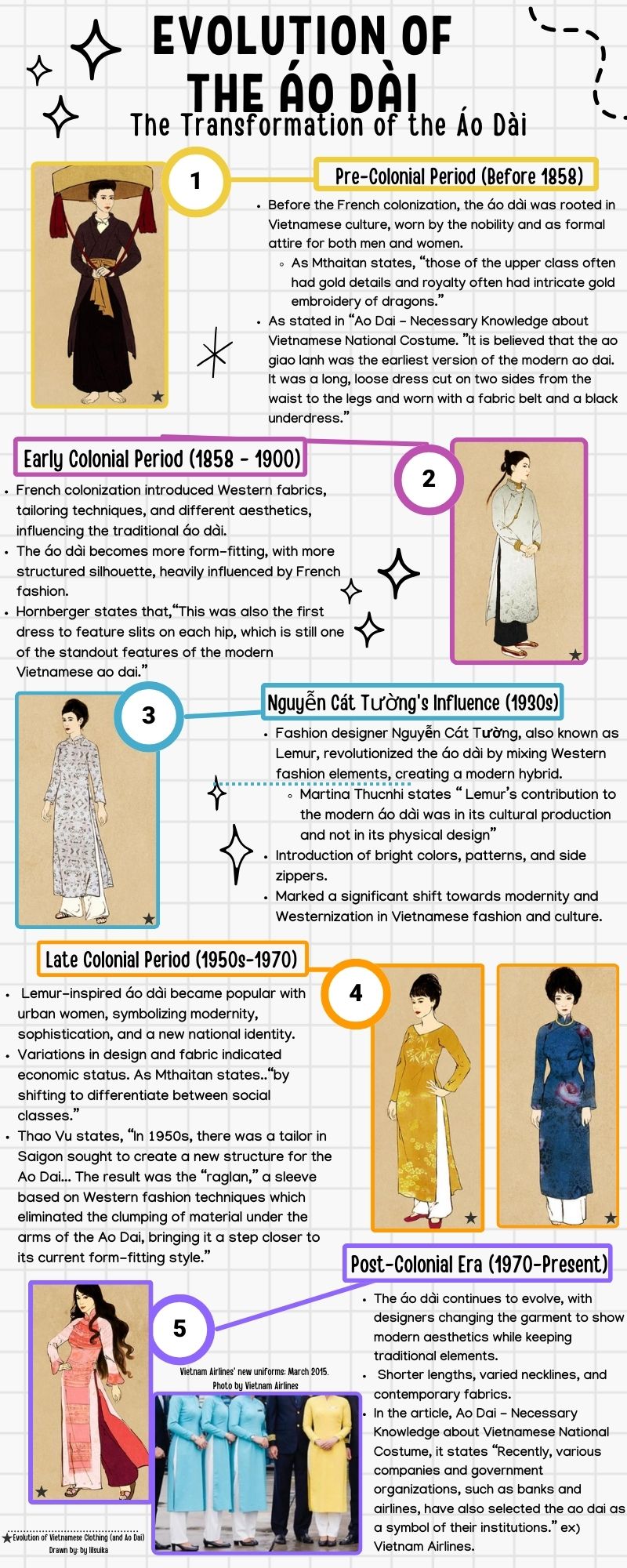
Visual depictions from that era gave birth to new norms and ideals of femininity. Brighter colors and imported fabrics of the West became coveted symbols of modernity and fashion around 1920. White trousers replaced old-fashioned black ones, and parting one’s hair on the side rather than in the middle also signified an embrace in shifting aesthetic tastes. Style was also indicative of economic status, with wealthier women wearing five-panel dresses while rural populations stuck to four-panel versions. Regional variations also emerged, such as the distinct “lotus leaf” collar styles that differentiates northern and southern dress. Beyond expectations for women, men also evolved grooming habits by incorporating shorter hairstyles to promote “neatness, simplicity, and hygiene” as a result of colonial influence.
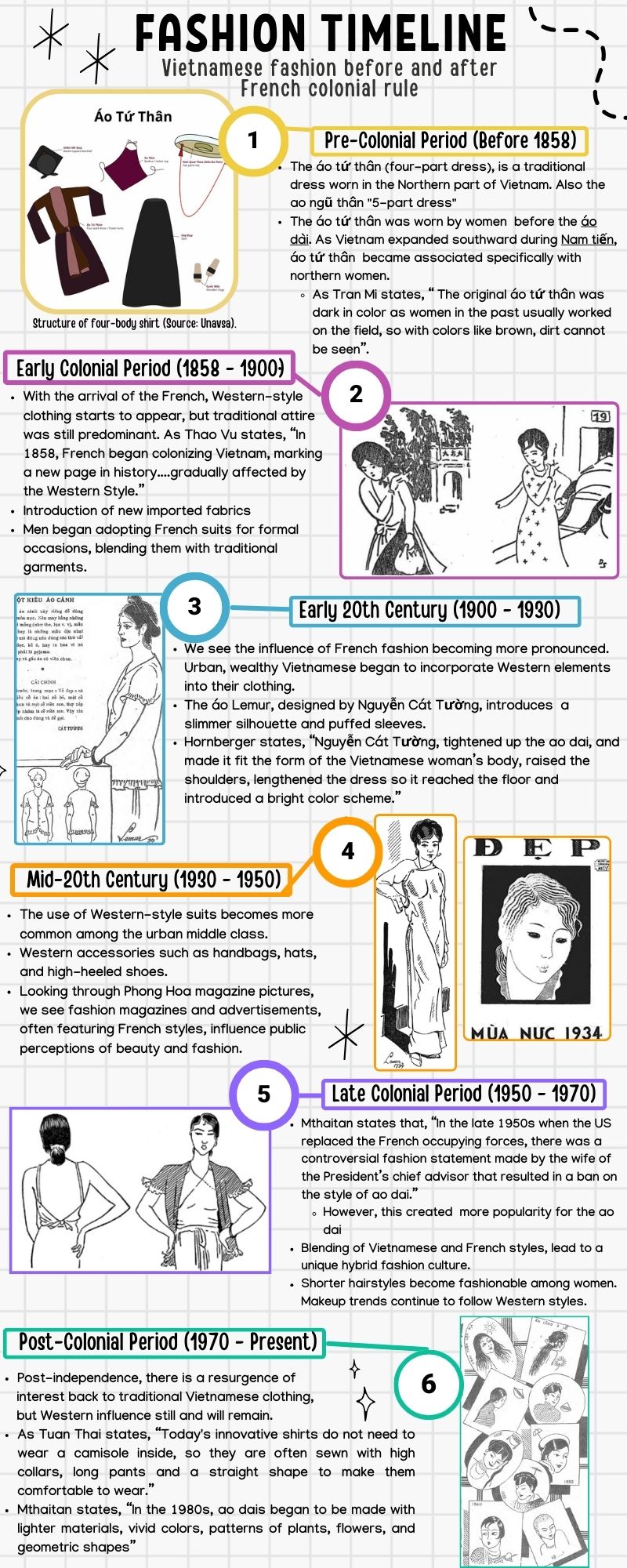
The intersection of French colonialism with efforts to modernize Vietnamese society is embodied by Nguyễn Cát Tường (or Lemur)’s writings. In his weekly “Beauty: Dedicated to Women Young and Old” columns, he advocated for reforms that went beyond just clothing, urging women to exercise moderately to match Western standards of physique. He recommended that colors should match the personal complexions and individuality of women. His writings walked a fine line, equating women to their appearance and sexual utility to their husbands. While his guidance often stayed within the boundaries of patriarchal roles, there was a movement away from costumes that strictly followed social codes and communicated nationality, and a shift towards embracement of individuality. This illustrates the patriarchal control that persisted even as material changes empowered women’s societal roles. As quality goods supposedly drove cultural progress and Westernization, the áo dài’s transformation into the “Lemur tunic” is symbolic of this nuanced dynamic.
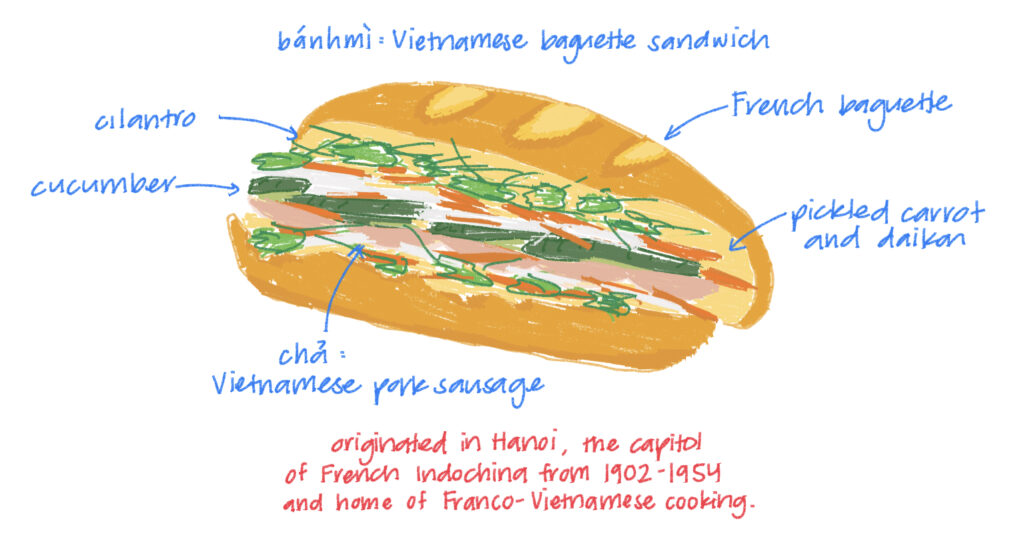
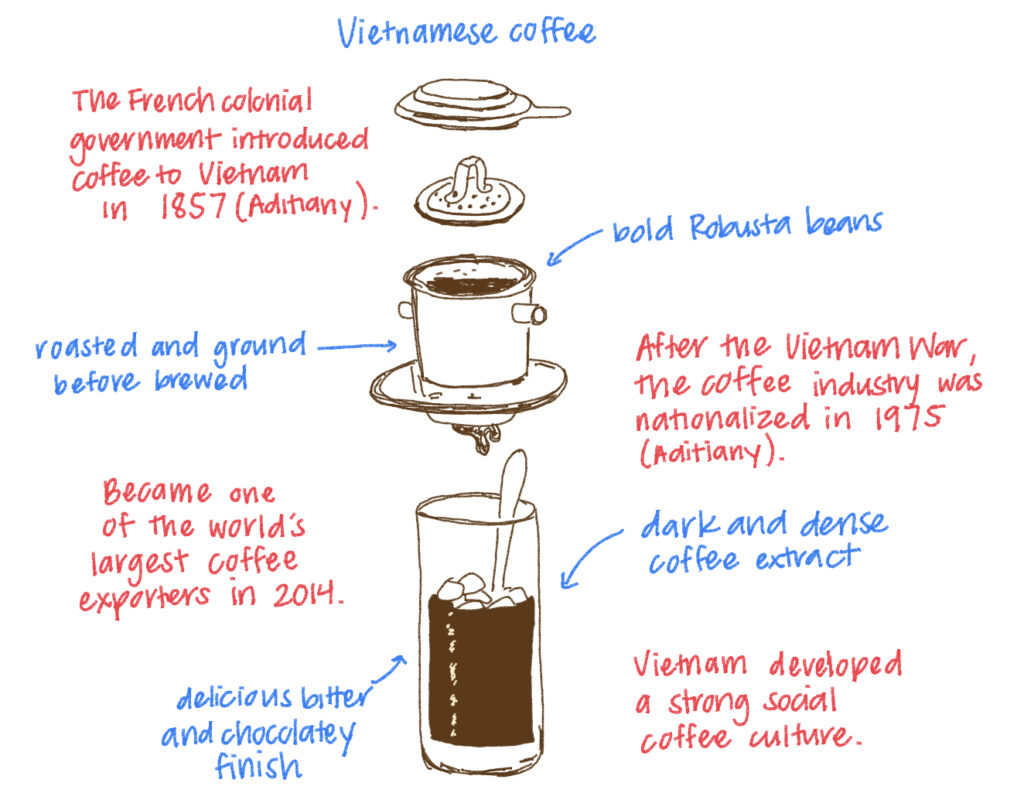
Another piece of life in Vietnam that has been affected by the French is their culinary culture. One of the most popular Vietnamese staple foods to date is bánh mì, a sandwich made on a baguette made with rice flour inspired by the French baguette, typically filled with other aspects of native Vietnamese cuisine like cilantro, pickled carrots, pickled daikon, and chả lụa (Vietnamese sausage). There was also an increased use of butter and wine in the preparation of meals, a sign of French practices being adopted. In 1857, coffee was introduced by the French colonial government to Vietnam and large-scale production began in the early 20th century. As a huge part of Vietnamese social culture, the act of drinking coffee and coffee shops heavily increased in popularity, serving as a meeting place and social activity. Vietnam’s unique brewing style for coffee and its distinct bitter yet chocolatey flavor helped it gain a lot of popularity around the world as well and are further explored in our visualizations.
Additionally, our project explores how these influences and nuances can be portrayed through a simulation of personal accounts, while emphasizing generational differences that Vietnamese families/diaspora face. Through our timelines and Twine interactive, we will incorporate side by side comparisons of traditional Vietnamese clothing and French influenced clothes while providing comments from different generations. Exploring this through a personal narrative–focusing on the lives of mother and daughter–will not only illuminate these changes from a more relatable perspective, but show how these changes may impact generational relationships and shared experiences.
Additionally, our project explores how these influences and nuances can be portrayed through a simulation of personal accounts, while emphasizing generational differences that Vietnamese families/diaspora face. Through our timelines and Twine interactive, we will incorporate side by side comparisons of traditional Vietnamese clothing and French influenced clothes while providing comments from different generations. Exploring this through a personal narrative–focusing on the lives of mother and daughter–will not only illuminate these changes from a more relatable perspective, but show how these changes may impact generational relationships and shared experiences.
Methodologies
Our primary dataset draws from Professor Cindy Nguyen’s collection of images and readings focused on decolonial perspectives within Vietnamese historical archives related to clothing and cuisine. While this provides invaluable documentation of the colonial influence, there are inherent limitations. Much of the material, including the widely referenced Phong Hoa magazine images, reflects the male-dominated perspective and patriarchal power structures of that era. The reforms promoted, even for traditionally feminine spaces such as fashion, were largely dictated by men’s ideals of nationality, beauty standards, and prescribed societal roles for women. Additionally, these urban-centric sources may not fully capture the experiences and modes of resistance among rural populations. With any dataset or source, it is important to consider that it only offers one perspective out of many, and likely excludes certain populations. Additionally, there is also a large amount of French influence after colonization that may affect the positionality of some of our sources.
Limitations
A limitation to our main source, Phong Hoa, is that it is one source that touches on many different aspects of Vietnamese culture during the era of study. There may be bias from just drawing from one source, especially when narrowing down the topic to just fashion and food, but supplementary readings allowed us to gather information to aid in interpretation of the images. These include On Our Own Strength: The Self-Reliant Literary Group and Cosmopolitan Nationalism in Late Colonial Vietnam and “Wearing Modernity: Lemur Nguyễn Cát Tường, Fashion, and the “Origins” of the Vietnamese National Costume”, both works by Martina Thucnhi Nguyen. One limitation of these sources are their primary focus on fashion and changes within that industry across a period of time. As they are not as focused on people’s personal accounts and experiences with colonial structures, they did not contribute directly to our Twine interactive.
To confront these limitations and deepen understanding of colonial impacts, we employ an interdisciplinary methodology. Personal narratives allow us to humanize the data and provide counter-narratives that center Vietnamese women’s voices, experiences, and agency across generations–often muted in colonial records. This qualitative approach complements the historical documentation and our project goals, creating space for marginal perspectives. Our choice of the Twine platform also facilitates an interactive and non-linear digital storytelling experience that mirrors the complexities of culture hybridity under colonial rule. Through a narrative following a mother and daughter’s shopping trip, users can explore the generational dissonances and evolving meaning of fashion. Our visual timelines and maps also situate the material into concrete, broader scopes of French colonial movements and Vietnam’s journey towards modern nationhood. Contrasting the mother’s recollections of pre-colonial traditions against the daughter’s navigation of new fashions and eateries illuminates how colonial ideologies reshaped gender norms and national identity in intimate, everyday ways.
Environmental Scan and Contribution Statement
Our project contributes to multiple intersecting fields and serves various audiences invested in decolonial understandings of Vietnamese history, gender studies, and curriculum development. Scholars of Vietnamese history and impacts of French colonialism will find value in our analysis diving into the everyday sphere of cuisine and clothing, where colonial hierarchies and hybrid identities materialized. Gender studies researchers focused on feminist perspective and intersections of patriarchy with imperial power structures can engage with our foregrounding of Vietnamese women’s voices and experiences that are often marginalized in colonial records.
Furthermore, our project holds significance by illuminating how traditional practices were radically transformed yet persisted through adaptation during the colonial era. Individuals from the Vietnamese diaspora may resonate with the represented generational divides and rediscover lost connections to their heritage. Educators can utilize our interactive digital storytelling as an experiential tool to critically examine dynamics of colonial legacies, gender norms, and national identity formation. By creating an immersive journey guided by archived materials and sources, our project welcomes diverse audiences to develop deeper understandings of Vietnam’s colonial past and its influences across time.
While researching and reading secondary sources, our team realized the importance of narratives from different perspectives. Due to the original idea of the project to be to focus on women and their experience with change in fashion and clothing, we naturally wanted to learn about the perspective of a woman. Though there are accounts of the physical evolution of clothing and food, we did not find stories of the emotional reactions to the change. Our Twine is one possible explanation that conveys a story told by a woman. We find it important to raise awareness of the missing information from Vietnamese narratives during French colonialism, but also in all records of history.
Contributors
Our project “Shopping Day” explores the influences of French colonialism on Vietnamese clothing and cuisine with emphasis on the lifestyles and experiences of women during the time. It is the result of a collaborative effort from a team of contributors. Jennifer, the Visualization Manager, crafted a timeline and written analysis detailing the transformations of Vietnamese fashion and culinary culture before and after French colonial rule. Ellen and Carly, our Publication Facilitator and Manager respectively, worked together to bring our story to life through the Twine platform to blend visuals and text, creating an immersive and interactive narrative. Anna, our Project Editor, translated the group’s research and ideas into a comprehensive narrative. While each member had distinct responsibilities within the project for sake of efficiency, the entire team collaborated closely to collect data, develop ideas, and review source material such as Phong Hoa articles. Through our research and engaging with class material, the group created an exploration of colonial structures that reshaped the cultural fabric of Vietnamese society and mundane life.
Works Cited
Aditiany, Savitri. The Influence of French Colonialism on Vietnam’s Culture. International Journal Of Applied Business And Economic Research, Vol. 14, No. 2, 2016
Hornberger, Jake. “The Evolution of the Ao Dai.” Vietcetera, 12 June 2024, vietcetera.com/en/the-evolution-of-the-ao-dai.
Mthaitan, Andrew. “Textile Traditions – Vietnamese Traditional Dress.” Introduction to Textile Media, 12 Oct. 2020, courses.ideate.cmu.edu/62-150/f2020a/textile-traditions-vietnamese-traditional-dress/.
Nguyen, Martina Thucnhi. On Our Own Strength: The Self-Reliant Literary Group and Cosmopolitan Nationalism in Late Colonial Vietnam. University of Hawai’i Press, 2022.
Nguyen, Martina Thucnhi. “Wearing Modernity: Lemur Nguyễn Cát Tường, Fashion, and the ‘Origins’ of the Vietnamese National Costume.” Journal of Vietnamese Studies, vol. 11, no. 1, 2016, pp. 76–128. JSTOR, https://www.jstor.org/stable/26377899.
Thao, Vu. “Ao Dai – the Vietnamese Charming Costume (Part 1).” Indochina Voyages, 6 July 2016, indochinavoyages.wordpress.com/2016/07/06/ao-dai-the-vietnamese-charming-costume-part-1/.
Tran, Mi. “Viet Phuc: Elegant and Symbolic Vietnamese Costumes besides Ao Dai.” Vietcetera, 14 June 2024, vietcetera.com/en/viet-phuc-elegant-and-symbolic-vietnamese-costumes-besides-ao-dai.
Tuan, Thai. “Những Mẫu Áo Dài Tứ Thân Truyền Thống Đẹp Duyên Dáng Ấn Tượng.” Thái Tuấn Fashion, 15 Mar. 2024, thaituan.com/ao-dai-tu-than.html.
Vietnam, Welcome to. “Ao Dai – Necessary Knowledge about Vietnamese National Costume.” Vietnamnomad, 5 Dec. 2023, vietnamnomad.com/featured-articles/ao-dai/.