Global History of Libraries: Colonial Pasts, *Decolonial Futures
This graduate course traces the global history of libraries as institutions of knowledge, spaces of reading, and technology of information organization. This course challenges discourses of libraries as a public good and neutral storehouse of knowledge and instead examines the contradictory politics of libraries and ways in which libraries have been reimagined through social practice. We will undertake a global and thematic approach to understanding libraries around the world, with attention to the role of colonialism and capitalism within development of libraries (in other words, not a historical survey, but a historically and culturally situated thematic understanding of libraries). We will also undertake an expansive meaning of ‘library’ to reimagine and position ourselves as contributors towards liberatory futures of institutions and more equitable worlds. This course draws from the intersections of fields of inquiry in history of the book, information, libraries; critical data studies/critical digital humanities, and colonial/postcolonial/decolonial studies.
Abridged Syllabus PDF, [Please cite/acknowledge my labor as you build upon this pedagogical and intellectual work.]
Creative Projects
Decolonizing Astronomy Zines
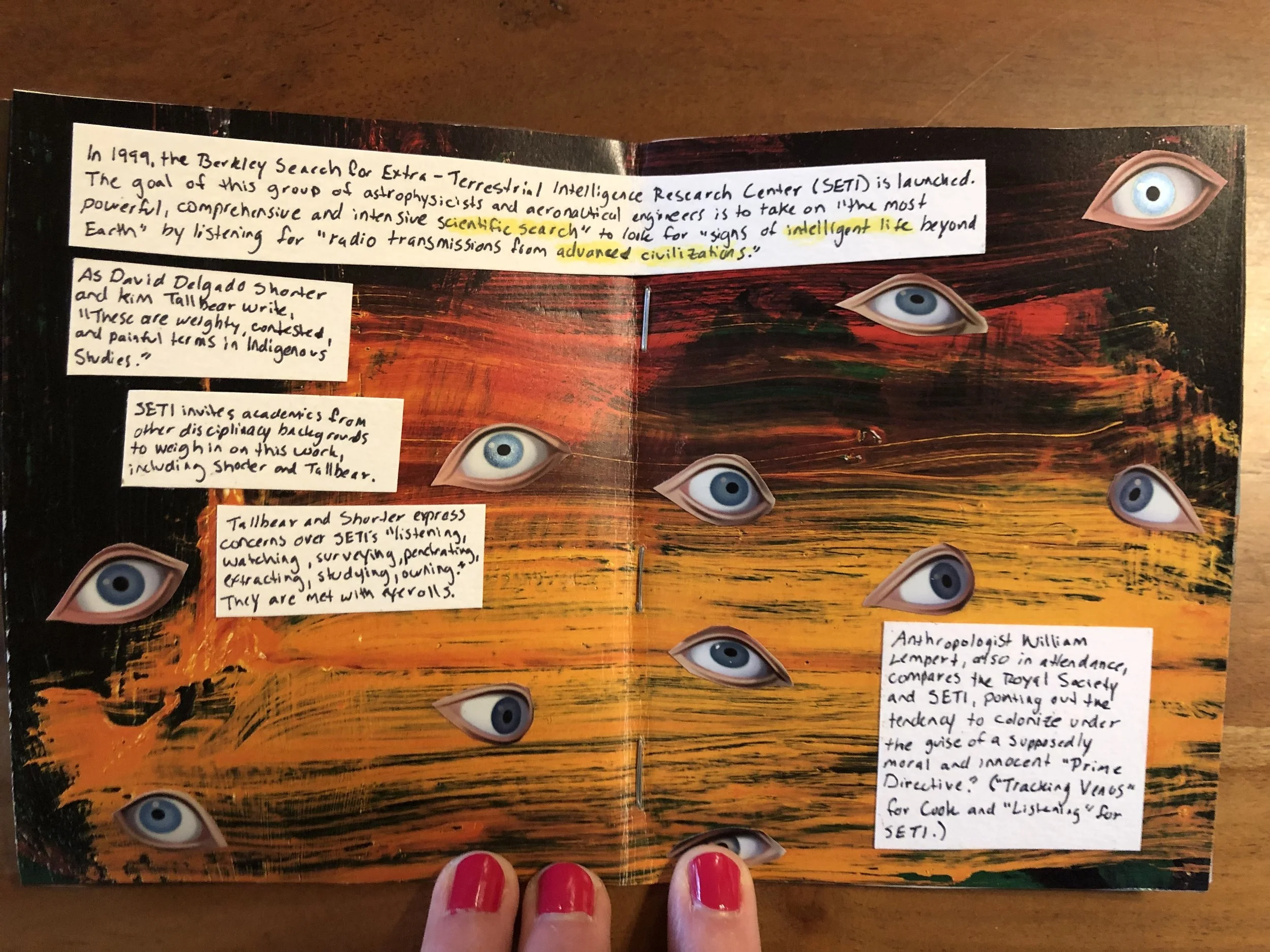
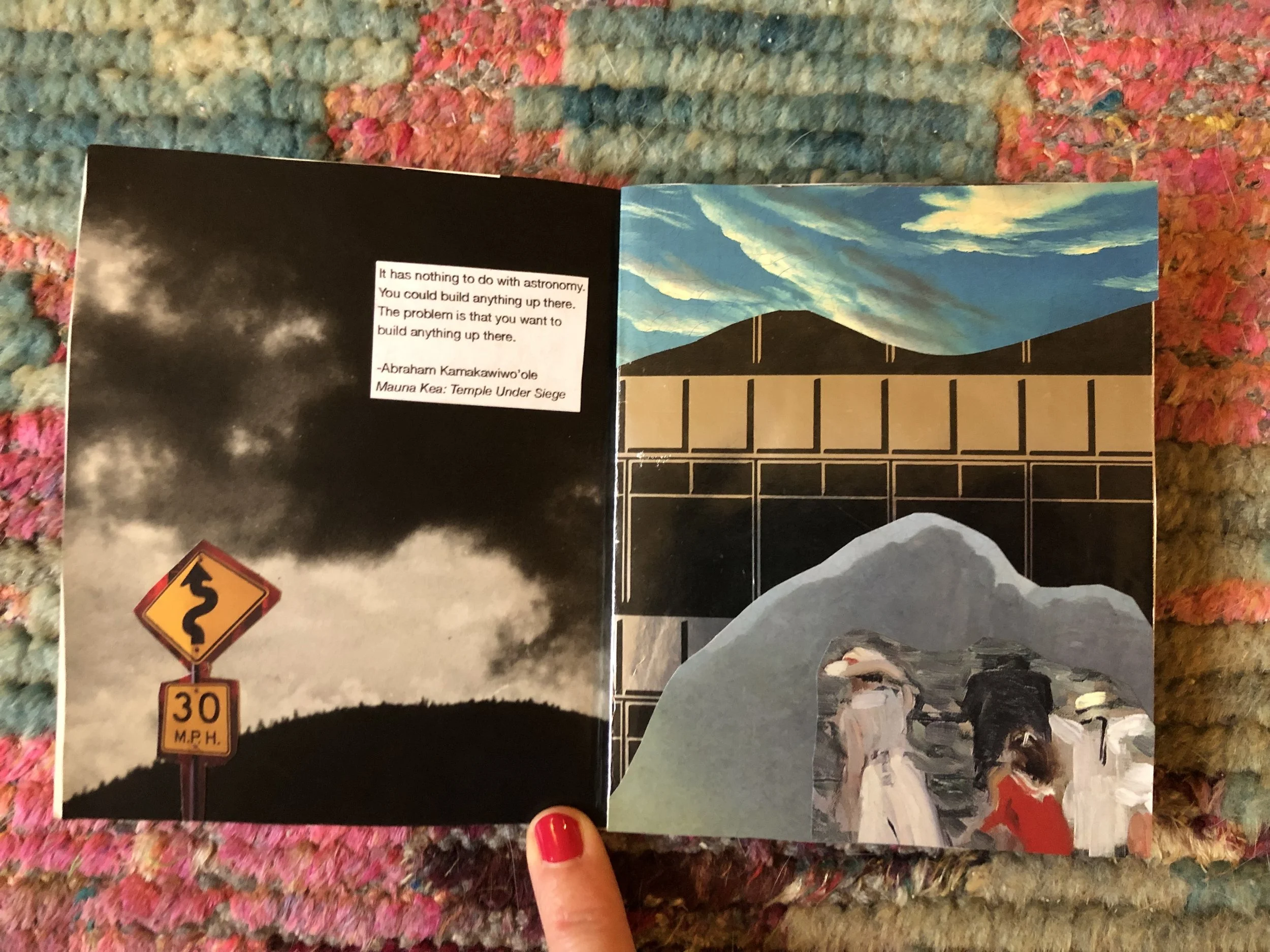
These zines attempt to reflect on the tension between Indigenous peoples and their cosmological ways of knowing and western astronomers and their studies, systems, and accompanying infrastructures. The first zines focus on the foundational theory of “astro-colonialism” and the second, a current event that exemplifies this aforementioned tension (the construction of the Thirty Meter Telescope (TMT) in Hawai’i).
View Introduction to Astro-Colonialism zine
View Mauna Kea and the Thirty Meter Telescope zine
Vision Board for Garmentmaking Project: Censorship in the Philippines
By Mariann Lactaoen (mlactaoen@g.ucla.edu)
Presented here is a vision board for a sewing project by which the sewist will create a terno/filipiniana imprinted with text from censored Filipino literature about the Spanish colonial and martial law eras.
E-Waste and Colonial Production
By Henry L. Davis III
A LibGuide on global electronic waste and its contribution to global warming and global labor exploitation
Decolonizing Academic Libraries Research Guide [Forthcoming]
By Marley Rodriguez and Noah Hernandez
This project is a LibGuide focusing on providing resources to academic librarians on how to decolonize their own academic libraries.
Our Class Narrative
Our class charter
→ We are
- people, learners, memory workers
- Valid in our memories and experiences
- Kind, caring and empathetic peers
- Part of the communities we “theorize” about!
- Learning!
- Capable of help and harm
- Come from diverse backgrounds and life experiences
- Trying our best
- Sharing this space together
- Unsure of the future but willing to meet it
→ Our values and class operating guidelines are
- Transparency, calling in not calling out, flexibility
- Holding empathy for one another.
- Saying ouch, recognizing mistakes (ouch and oops)
- making sure that we are not speaking in the place of marginalized communities 🙂
- Speaking from “I” perspective (one’s own perspective)
- Valuing the discomfort, creating space for growth
- Listening with intent to understand
Part 1 Pasts
Shared vocabulary, a foundation to work through collectively
Week 2 April 9: Colonialism and its Histories in a Library
Leena, Mariann, Aimee, Kristen, Kady: Several of these readings address the prospect of people of color as complicit in systems of colonialism and white supremacy. How do these authors grapple with this idea – and how can you?
[Creating space for conversation through dynamic poster activity]
[Grounding our discussion in land and kinship]
Week 4 April 23 : Critical Design & Media Restitution
[Conversations on positionality and creative restititution]
Week 5 April 30 : Revisiting Decoloni*: Theory & Practices
Marley, Ben, Hannah, Sam, Althea
- Maldonado-Torres introduces his ten theses with a critique aimed at liberal institutions, calling attention to the academy and its systematic and violent repression of decolonial student movements. In what ways can you see his ten theses (thinking specifically about the one you read) reflected in his critique of the university and the academics/employees that distance themselves from these movements?
- In Acknowledging Indigenous Nationhood, Sovereignty: A Library’s Obligation, Wong talks about Olson and Schlegel’s five criteria for evaluating how classification systems describe marginalized communities. (Treatment of the topic as an exception, Ghettoization of the topic, Omission of the topic, Inappropriate structure of the standard, Biased terminology). Wong proposes adding “historicizing of topics and peoples” to Olson and Schlegel’s five criteria. Additionally, Maldonado-Torres’ writes that “Coloniality is different from colonialism and decoloniality is different from decolonization” (Thesis Two), suggesting that decolonization/colonialism is depicted as past realities/historical episodes but that coloniality/decoloniality refers to “a logic, metaphysics, ontology, and a matrix of power that can continue existing after formal independence and desegregation”. In what ways does the idea of/relationship with time and temporality relate to these two ideas?
- Thinking about “Our Stories, Our Knowledges,” what ways do you practice self-care that don’t “originate in the wealthy (often Western) world?”
[An interlude, an invitation towards praxis, witnessing the encampment]
Part 2 Futures
Creating, Dreaming, Processing
Week 6 May 7: Epistemology, Centers-Peripheries, Global
Henry, Noah, Michaela, Mads, Jeanelle: Million describes that it is in the Western epistemologies’ nature to “contest or extinguish rival knowledge claims” (340). In what ways can library professionals include other knowledge formations (like Indigenous epistemologies) in (inherently exclusionary?) Western institutions (libraries)?
[Remote gathering…Where do we go from here? grounding ourselves into indigenous epistemology “open systems reflexively formed in the same cauldron of living story, conjecture, place writ large, and practice that produce our own conceptual maps” Dian Million, “Epistemology” in Native Studies Keywords, 2015]
Week 7 May 14: Circulations, Land, Bodies, Vernaculars
Chelsea, Jane, Trinity, Julissa, Tatiana: How has food been a form of resistance in your own family, kinships or community? What are the ingredients and how have they been informed by colonialism/decolonialism?
[Finding community in the LAPL Westwood branch…Having difficult conversations with ourselves and others]
Week 8 May 21: Speaking Nearby, Queer Futures, Fragmentation Archives, Critical Fabulations
Riona, Eliana: Since LCC is mostly viewed by the catalogers, or the holders/organizer of knowledge, in using this classification system, they are continually reinforcing the idea of the norm as being a heterosexual white man, what does it say about accessing knowledge in academic institutions within the United States and how could Queer Theory present answers to shift from these structures?
Week 9 May 28: Arts, Digital, Labor, Disability
Mati, Abigail, Annie: How should/could the digital humanities address the preservation of cultural heritage that is not written? How do embodied forms of knowledge such as dance, music, oral history, cooking, etc. fit into the digital record? How does “digitization” alter these knowledges?
[Back on campus…strike…Sharing my arts/community self misreading, Open in Emergency and tarot, playful gathering of care]
Week 10: Celebration
→Instructor Pleasure Narrative of IS 289 & Gratitude (Finding Your Purpose by Hannah Alpert-Abrams)
Pleasure – Page 34-41
Pleasure activism is the work we do to reclaim our whole, happy, and satisfiable selves from the impacts, delusions, and limitations of oppression and/ or supremacy.
Pleasure activism asserts that we all need and deserve pleasure and that our social structures must reflect this. In this moment, we must prioritize the pleasure of those most impacted by oppression.
Pleasure activists seek to understand and learn from the politics and power dynamics inside of everything that makes us feel good. This includes sex and the erotic, drugs, fashion, humor, passion work, connection, reading, cooking and/or eating, music and other arts, and so much more.
Pleasure activists believe that by tapping into the potential goodness in each of us we can generate justice and liberation, growing a healing abundance where we have been socialized to believe only scarcity exists.
Pleasure activism acts from an analysis that pleasure is a natural, safe, and liberated part of life—and that we can offer each other tools and education to make sure sex, desire, drugs, connection, and other pleasures aren’t life-threatening or harming but life-enriching.
Pleasure activism includes work and life lived in the realms of satisfaction, joy, and erotic aliveness that bring about social and political change.
Ultimately, pleasure activism is us learning to make justice and liberation the most pleasurable experiences we can have on this planet.
Pleasure Activism by adrienne maree brown, 13