By Cindy Anh Nguyen
[Updated March 24, 2026]
Please cite this pedagogical design and feel free to remix and tailor for specific communities. A forthcoming open access publication on this class design with additional resources and clickable links will be published in 2026-2027. I would love to hear feedback and your perspectives on adapting this design, please email me at cnguyen@seis.ucla.edu
A Note for Instructors
During Fall 2025 at UCLA, I redesigned my two classes where the final projects are completed aligned and co-produced with and alongside community partners based in Southeast Asia. The courses were an undergraduate course on Information & Visualization of 25 students with more technical leaning skills and a graduate course on introduction to digital humanities and project management with 12 students with more critical research learning skills. The two community partners during 2025 were Southeast Asia Artistic Freedom Radar SEA RADAR (based in Singapore) which documents violations of artistic freedom in Southeast Asia and An AI of Our Own AAOO (based in Cambodia) an initiative on innovating community-led AI for cultural preservation and transmission across the global south. Both organizations were facilitated through my existing relationships and community engaged scholarship in the Southeast Asia region, and were selected based on the community needs aligned with the goals and learning outcomes of the class: digital communication, information visualization, cultural heritage and AI prototyping.
This Teaching Design Template communicates the class design–from stages and timeframes for students, as well as communication with community partners regarding the pedagogical goals, informational interviews, and co-designed datasharing protocol. This template functioned as a living document throughout the period of engagement (5 weeks), where student, teacher, and community partner goals and roles were communicated and documented for asynchronous engagement. Two stages of synchronous engagement and exchange were scheduled given workload and time constraints.
Class Design
Through working with community organizations over the course of one quarter, students practice research design and empathy, grounded in specific organization needs and global cultural contexts. This approach provides a foundational social and intellectual skill set for careers in research, community organization, and industry. In research teams, students then codesign interventions, suggestions, and prototypes with and for the community partner, ensuring all work is aligned with the collectively identified key values, needs, and goals of both the community partner and the research team. Key to the success of the project is providing students the ethical, contextual, and design foundations prior to starting the final projects (first half of class, 5 weeks). A sample of the syllabus and readings are available here.* In this way, students come in designing projects not as techno-solutionist, but as grounded in human relationships, project management clarity of roles, goals, values, and technical capacities. Besides the ‘prototype’ with the community partner, the expectation for student teams is to create a structured, extensively researched Narrative Statement that outlines the key design intentions, processes, and goals to scope the project and communicate with partner.
To ensure the work is ethically grounded and technically sound, I designed a four class sessions of Dialog-Pitch, Data Audit, Showcase, and Iteration aligned with final project milestones 1-4 (Descriptions below). During these four phases, students dialoged synchronously with the community organization, created groups based on their interests and interventions, developed projects within a peer and instructor audit check in, presented their findings and prototypes to the partner, and iterated based on class, instructor, and community partner feedback. This process requires students to scrutinize their own technical outputs—such as mockups or visualizations—against the partner’s actual data constraints and ethical requirements and within the feedback of their peers and instructors drawing from an extensive course foundation in global data, design ethics, and project management. This iteration phase is crucial where it teaches students that “innovation” in the humanities is not just about the final product, but about the recursive, value-aligned process of adjusting one’s work to meet the evolving needs of a community. Final projects were ambitious yet scaled and tailored to specific needs and included prototypes of cultural heritage apps designed with ethical AI workflows, research projects on indigenous data sovereignty, and data visualizations on artistic freedom in Indonesia and Malaysia.
Asynchronous and Synchronous Dialog – Week 4
Community partners completed ‘informational interview’ questionnaire below and visit class to present organization, key needs and goals.
Pitch and Project Scaffolding – Week 5 [Class Milestone 1 Assignment]
Students form groups based on their interests, personal-technical-design goals.
Student Team Work – Week 6, Week 7
Narrative Statement Rough Draft and Feminist Data Audit – Week 8 [Class Milestone 2 Assignment]
The rough draft is an attempt at the full narrative statement for the final project. It can have elements of outlines and screenshots of attempts of visualizations. The rough draft will be submitted to google doc on bruinlearn by * midnight. Be prepared to present your messy draft in class during week 8. Class time on * will be dedicated to peer and instructor feedback “Feminist Data Audit”.
The Rough Draft of Narrative Statement can be structured like an essay, annotated outline, and at the minimum have the following:
- Describe your project idea in two sentences
- Which dataset(s) will you work with
- What are the core problems or needs your project seeks to address?
- What methodologies or tools will you plan to use
- How is data critique a fundamental part of our project?
Feminist Data Audit – Week 8 [In Class]
Pairs of teams will audit each other using the following framework and questionnaire. Each group reads through the narrative statement and evaluates the existing project design based on the 7 principles of data feminism. Afterwards teams meet to discuss next steps on how to revise and incorporate feedback. Instructor also provides feedback to each group individually as a check in audit phase.
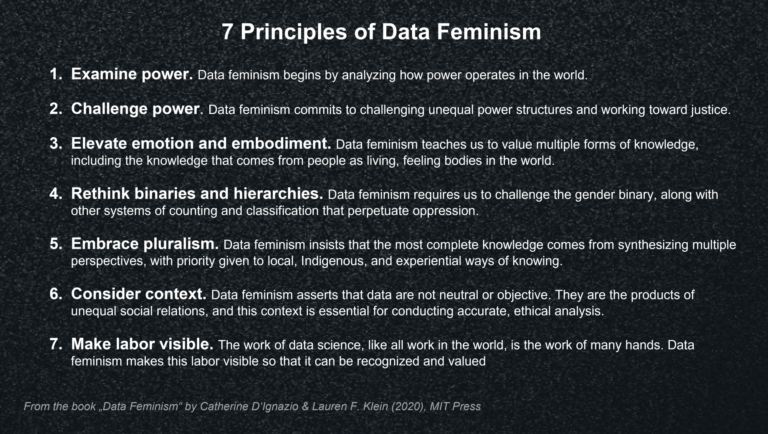
Example of One Data Audit on an AAOO Project
| Principle of Data Feminism | Y/N | Notes |
| 1. Examine Power | Y | This project does examine power as it aims to explore how biases, the black box phenomenon, etc. play into issues with Global South access to AI. By stating that they aim to uplift Global South communities with cultural heritage preservation, the group indicates that they are examining how to increase the power of voices that are suppressed by current technological access. |
| 2. Challenge Power | N | While it does discuss methodologies of resistance like “properly documenting workflows” that can create a collaborative and reproducible DH project, it does not explicitly aim to challenge power. Instead, their project aims to empower AAOO to help communities more strategically. |
| 3. Elevate emotion and embodiment | Y | The project intent shows that they aim to explore existing community initiatives aimed at providing more equitable access to AI. This direct interaction with projects and the humans behind them, as well as prioritizing humans in the workflow outline, should allow the group to highlight the tangible/human aspect of this issue. |
| 4. Rethink binaries and hierarchies | The project challenges the assumption that technological expertise must come from Western, well-resourced institutions. By looking at how Global South groups define and share their own practices, the project challenges the idea that AI or digital heritage work must follow one expert way of doing things.Binaries and hierarchies are being questioned through the methodology of the project, because instead of having already existing tech (typically made for a Western context) and then bringing it into Global South context, this project looks at research that was done specifically for these communities in mind and sees what we can learn from them. | |
| 5. Embrace pluralism | By auditing existing community initiatives around the world and how these communities are communicating their goals, it brings in a pluralist perspective. | |
| 6. Consider context | Not yet | While this is not currently listed in the project description, I am sure that considering context (like geographic location, language, political environment, and aim of the project) is vital to accurately assess the commonalities and differences between these projects Potential question/critque: “Identifying specific communities that could benefit from AI in cultural heritage preservation” heavily consider if you have enough context for these communities and why you choose certain ones over others. |
| 7. Make labor visible | Not yet | Both by citing specific projects and by outlining a workflow with best practices for future projects, this group can use documentation and multi-media depictions of the “discovery” and “doing” processes to highlight the data labor doing into these projects. While there are no specific examples of projects provided or any documentation for workflow steps, it is clear this is part of the intent of the group. |
Reflection To Do:
–
–
| Principle of Data Feminism | Y/N | Notes |
| 1. Examine Power | ||
| 2. Challenge Power | ||
| 3. Elevate emotion and embodiment | ||
| 4. Rethink binaries and hierarchies | ||
| 5. Embrace pluralism | ||
| 6. Consider context | ||
| 7. Make labor visible |
Reflection To Do:
—
Group Showcase with Community Partner for Iteration Phase – Week 10 [In Class]
Prepare a 15 minute concise, enticing, and pointed presentation, (5 minutes Presentation, 5 minute class and instructor Q&A/Feedback, 5 minutes for community partners). Don’t go into the super details, a few key explanations are fine. Instead focus on the narrative. Address the critique and creation framework within your presentation. You can think of this presentation like a “200-word abstract” of your research that invites readers to think about your major questions and contributions. The goal of this showcase is not to present a final product, but to invite key stakeholders (instructor, classmates, community partner) into feedback and design process to incorporate into final design.
Final Revised Submission – Finals Week
After the presentation, integrate feedback into the statement and project. The total length of the statement will be approximately 3-5 double spaced pages. (Outcome): Given the internal nature of this term with community partners, the final project will be uploaded as a google folder with the Narrative Statement, any visual displays such as prototypes or visualizations as SVG or PNG, or google slide deck. The final submission of the project is accompanied by a detailed self-assessment and assessment reflection. As part of your final submission, please complete this self-assessment and group-assessment reflection. This is the most important part of class and final projects, and is an anti-busy work space for you to reflect on your learning journey.
Communication with Community Partners
Background and Pedagogical Goals
Through working with community organizations, students practice research, empathy, exploration of the existing project with key stakeholders and understand the key needs and goals; second students can design interventions, suggestions, prototypes for the partner, with the possibility to pitch them to the community partners and iterate. Community partners range from global, Southeast Asia specific community organizations, digital archives, as well as smaller scale, grassroots community projects. Depending on scheduling and time zone challenges, some of the ‘informational interviews’ will be asynchronous and hypothetical, based on analysis of what the community partner communicates on this document below as well as their website. Students will prepare ‘information interviews’ with the community organizations based on design principles of strategic planning: understanding the problem, defining goals, identifying opportunities/constraints, developing a plan, measuring effectiveness. This type of practice based interview will help students to engage with digital humanities concepts of “Minimal Computing” (Risam, Gil, 2022) in real world case scenarios. Furthermore, given the urgent context of termination of funding that has funded digital humanities and digital archives-library projects for decades (National Endowment for the Humanities Digital Humanities Advancement Grants; Institute of Museum and Library Services) I will center real funding challenges and actionable practices within “project management” approaches to guide students on how grassroots organizations have and continue to organize, provide resources for their communities, and do important work as models for digital humanities praxis.
Community Partners Preliminary “Informational Interview” for Final Projects
Datasharing Code of Conduct for Students and Community Partners
The community partners An AI of Our Own have generously agreed to share a selection of data for internal use only. This means that the data cannot be distributed beyond this class, Fall 2025.
Groups will design mockups, pitches, data visualizations, and prototypes working with the data, and submit them to the community partners for review. Some students might want to submit some of the final projects as part of public facing, academic, and professional dossiers or portfolios (on personal websites, linked ins, for job applications), and community partners will have the right to request student groups to anonymize, amend, or adjust the public facing pitch (for example, in cases where the community organization does not want affiliation with the project down the line given its beta-prototype stage).
[Example Community Driven Data Protocol: Upon completion of the project, all parties must commit to dispose of/ permanently delete all data sets provided by * including those downloaded, duplicated, shared as attachments from personal devices, shared drives, and institutional platforms. ]
[Example Community Driven Data Protocol: For transparency and accountability all access to data sets shared by AAOO not limited to reads, queries, and downloads on personal or institutional devices by individuals or groups must be logged with the user ID, timestamp, device type, and purpose. A copy of these logs should be available upon request and at the end of the semester. Our data is considered community property as such should not remain in possession of students’ and institutional devices unless an agreement is reached and permission is granted on special circumstances.]
Since this is not an official contracted client-service agreement with ‘intellectual property rights’ we will move through this pilot community based – education partnership in a respectful, communicative case by case discussion as final projects develop. After the class concludes, the community partners might want to move forward with some of the pitches the students designed, and will work out with the student teams to properly attribute labor, intellectual development, and academic context within Professor Cindy Nguyen’s courses.
Blank Questionnaire
Name of Community Partner
Reference Website:
Priority: ?
Short Description of some key research questions, outcomes, directions of either research or visualization tasks:
Links and Instructions to specific datasets: ?
———————————–
1. An AI of Our Own
Reference Website:
Priority: ? Research and Design
Short Description of some key research questions, outcomes, directions of either research or visualization tasks:
Target Audience: Community members i.e. End Users, Researchers, AI ethicists, and Enthusiasts, Cultural heritage professionals.
Datasets: Plant based Indigenous Knowledge Systems (South Africa), Smot Chantings(Cambodia), and Ikat weaving technique(Cambodia).
Direction: The strategic direction is to identify and prototype an innovative AI tool /Model for diverse forms of cultural heritage fit for Global South communities and global communities with connectivity issues. We envision an AI tool with an authentication engine for the discrimination of counterfeit and original traditional weaving patterns using blockchain technology. In addition to this, we aim to articulate the issues around cultural heritage bias and misrepresentation in AI tools and models and existing gaps with ethics, governance and sovereignty but not limited to model hallucinations and “Blank Data” issues.
Problem: Dealing with diverse cultural heritage forms from different communities across different geographical and cultural zones, to develop an AI tool that is user-friendly across all the Global south regions and communities. The AI black box phenomenon in AI models and Global South cultural heritage data in the models.
Deliverable 1: Develop an Empathy Map and Problem Definition Report
Deliverable 2: Co-design and develop a 3 low-fidelity concept with sketches for an AI tool.
Deliverable 3: Develop an Interactive and scalable prototype (AI design Mockup) capable of handling diverse cultural heritage forms from diverse communities across Global South borders with blockchain technology for traditional weaving patterns.
Output 1: Interactive Prototype
Output 2: Peer-reviewed paper
Output 3: Feasibility study report on the interactive and scalable prototype.
Links and Instructions to specific datasets:
ATT: Train data will be shared during the research and design process and students will be given access to the project’s Hugging Face projects for datasets and models with permission to commit.
–
Appendix:
Background on Class Skills and Outcomes for Community Partners
The class takes place September 25 to December 14, 2025, with the majority of the project development occurring in mid October to mid December. The class takes place Tuesdays and Thursdays 9AM- 12PM PST, if there are any days that might work for a community organization to join our class via zoom, this would be wonderful for the student teams to meet you. Through working with community organizations, students practice research, empathy, exploration of the existing project with key stakeholders and understand the key needs and goals; second students can design interventions, suggestions, prototypes for the partner, with the possibility to pitch them to the community partners and iterate. Community partners range from global, Southeast Asia specific community organizations, digital archives, as well as smaller scale, grassroots community projects local to southern California/Los Angeles. Depending on scheduling and time zone challenges, some of the ‘informational interviews’ will be asynchronous and hypothetical, based on analysis of what the community partner communicates on this document below as well as their website. Students will prepare ‘information interviews’ with the community organizations based on design principles of strategic planning: understanding the problem, defining goals, identifying opportunities/constraints, developing a plan, measuring effectiveness. This type of practice based interview will help students to engage with digital humanities concepts of “Minimal Computing” (Risam, Gil, 2022) in real world case scenarios. Furthermore, given the urgent context of termination of funding that has funded digital humanities and digital archives-library projects for decades (National Endowment for the Humanities Digital Humanities Advancement Grants; Institute of Museum and Library Services) I will center real funding challenges and actionable practices within “project management” approaches to guide students on how grassroots organizations have and continue to organize, provide resources for their communities, and do important work as models for digital humanities praxis.
Approximately 25 students in the Undergraduate 112 class will have more ‘technical’ experience with data visualization, and approximately 25 graduate 201 class will have more ‘research’ design and project management skills. Students will work in group sizes from 3-5 and select the topic and community partner they would like to work with.
Outcomes and Deliverables with/for Community Partners
(1) Client-facing pitch focused on Technical: For the final group project, they will design a pitch to address the needs raised by the community organization applying the digital and technical skills they learned in their Introduction to Digital Humanities and Information Visualization course. The final pitch will include a beta with mockups and screenshots and should be at the scope and scale of which is doable within the term (about 5 weeks). Examples of deliverables might be data visualizations, user experience and design feedback mockups, text analysis, mapping projects, AI design mockups.
(2) Client-facing pitch focused on Publishing/Public Communication: Drawing from the important work in digital humanities that expands the idea of ‘publishing’ I invited students to contribute towards publishing a wider array of digital resources which they will pitch and design to support and address the needs of the community organization. Example deliverables include the following: annotated and well structured data via Github, Humanities Commons, or Open Science Framework; slides videos and tutorials via Zenodo; open educational resources and pedagogical reading lists and learning resources on specific topics (such as AI for global south/global majority); for more advanced students, collaborative authored pieces for publication in peer review digital humanities journal for data (Journal of Open Humanities Data, Post 45 collective, Journal of Interactive Technology and Pedagogy).
Informational Interviews Questionnaire
Guided Questions in Informational Interviews/Design Thinking and human centered approach (needs, technological possibilities, logistical structures)
- What do you identify as the most critical problem?
- What does success look like?
- What are the short-term goals and tasks?
- How might they move towards and relate to long term goals?
- What are the most pressing everyday challenge?
- What are the most pressing long term challenges?